
“The number one benefit of information technology is that it empowers people to do what they want to do. It lets people be creative. It lets people be productive. It lets people learn things they didn’t think they could learn before, and so in a sense it is all about potential.”
– Steve Ballmer
The world is ever changing, and so are people, and one of the most important steps in building a successful business is to embrace technology and data. Because let’s face it, data is at the core of it all. And data has been around for ages, even before we realized we were basing our decisions on it, whether to invest in something on the east side, or how much, or in what, depending on the market data, customer data, revenue generation, we were just not aware that it was data, records that helped us. And now we are, so this brings us to one of the most sought-after questions of modern times “How to Build a Successful Data Strategy for Modern Enterprises?”
We can obviously ask ChatGPT or any other AI chatbot, which, to be honest, will produce a great, well-thought-out list, but then again, can it be humane enough? Coming from a person like you, who has dreams and ideas and is looking to turn their baby into a success using data? And if you are like me and prefer it to come from our fellow humans, then you’re in the right place. In this age of AI, I prefer to write and read things that are still written and well-researched by humans.
The most current frameworks help clarify the primary purpose of their data and guide strategic data management. Whereas it should be business-focused, it should be about having a framework where data works in your favor, not just managing. So, what is this phenomenon? It’s the Data Strategy Framework.
What Is a Data Strategy Framework?
It is a structured framework for organizations like yours to manage, govern, use, and maximize the value of data and transform it into successful business objectives. It facilitates the blueprint for how data is collected, stored, secured, and analyzed, and transformed into insights that can be taken into consideration and turned into actions. The Data Strategy Framework defines how data will help your business achieve success on your terms, not just for data management or for the sake of records.
It is a structured framework for organizations like yours to manage, govern, use, and maximize the value of data and transform it into successful business objectives. It facilitates the blueprint for how data is collected, stored, secured, and analyzed, and transformed into insights that can be taken into consideration and turned into actions. The Data Strategy Framework defines how data will help your business achieve success on your terms, not just for data management or for the sake of records.
By implementing a well-defined data strategy framework, organizations can improve data quality, strengthen governance and compliance, enhance operational efficiency, enable advanced analytics and AI initiatives, and drive innovation at scale.
The key components for a Data Strategy Framework are –
Business Alignment
The first action of this framework is to have business goals clearly defined and then to be aligned with your data and its initiation.
Data Governance
Defining the policies, processes, and responsibilities for managing and collecting data.
Data Architecture
This stage is about how to store data, integrate and access it across departments and teams.
Data Quality Management
This one is about ensuring data’s quality – accuracy, completeness, consistency, and trustworthiness.
Data Security and Privacy
This is about guaranteeing the protection and security of sensitive data and enforcing compliance with regulations.
Analytics and Insights
This one is about using tools and employees’ brains to leverage data and convert it into business intelligence to inform decisions.
Data Culture and Literacy
Train and encourage employees and teens to use data smartly.
Striking A Balance
A successfully working data strategy framework is not built on data alone – it is built around business outcomes and how data can be integrated to achieve them. Organizations commonly make the mistake of either fixating on business objectives without understanding or approaching them from a data angle, or investing just in data initiatives without a clear, strong link between strategic business goals and data.
Striking a balance means aligning data and all activities with the organization’s priorities and targets while ensuring data remains accurate, accessible, secure, and transformable. Upper management defines the goals and outcomes they want to attain, while data teams and analysts work together to transform the data into information and insights. Striking a balance is not a one-person or one-team task.
This harmony creates a customized data strategy framework tailored just for you and your organization, aligned with your unique goals and challenges, and focused on your customer satisfaction. Business priorities change as per the market, customers’ needs, and a million other factors. Your data strategy framework should adapt accordingly, ensuring that data continues to drive informed decision-making and doesn’t hang around as dead weight. Or you can reach us at accel bi, and we can help you.
Simply put, the most effective data strategy frameworks treat data not as an end goal, but as a strategic enabler of business success.
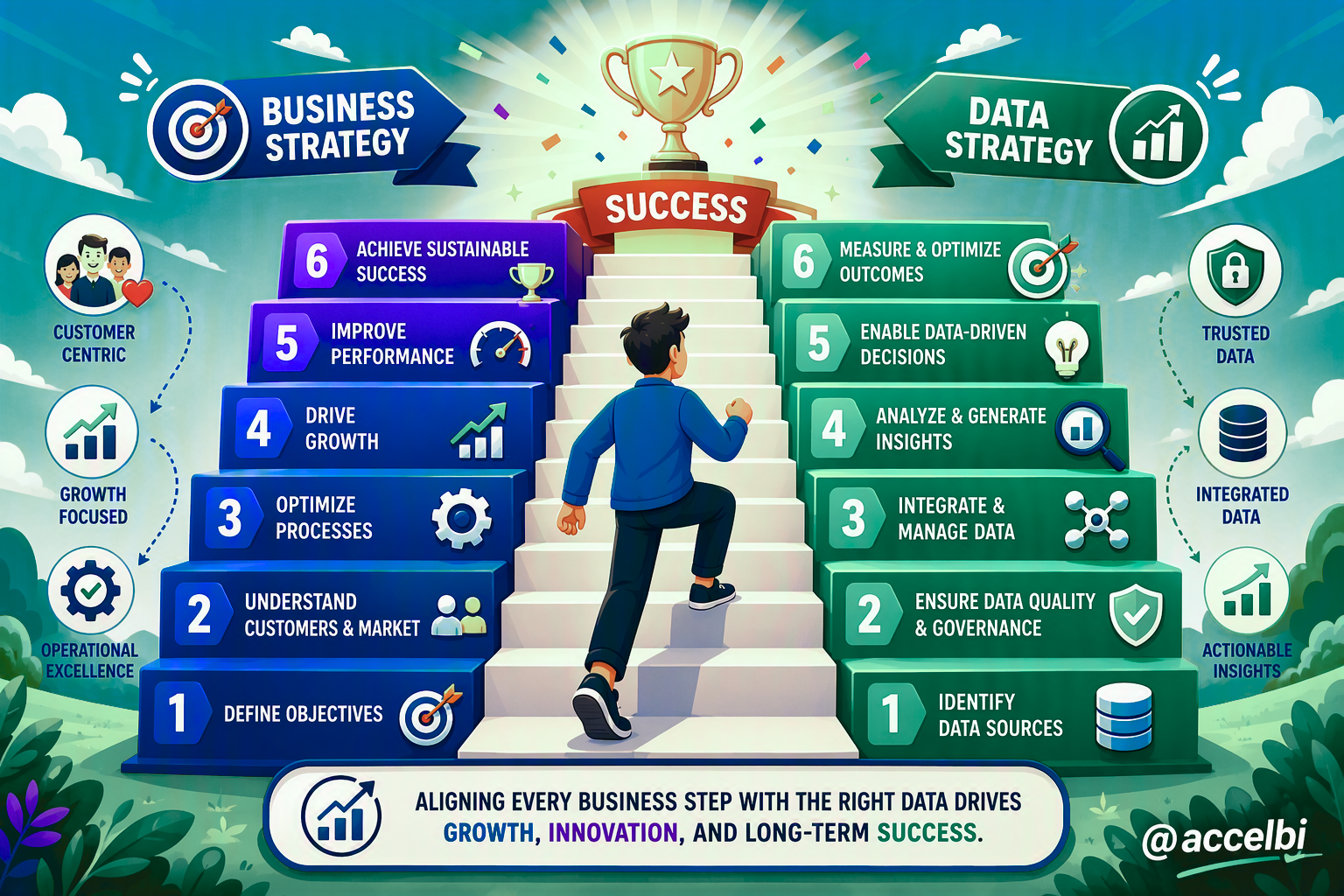
Matching Your Steps With Data
A common mistake organizations make when developing a data strategy is treating data management as a standalone initiative rather than a business enabler. Collecting, sorting, governing, and analyzing data are important activities, but they deliver little value when disconnected from strategic objectives. A successful data strategy framework requires organizations to work on their business goals and data initiatives side by side, ensuring that every data-related decision supports a business-aligned outcome. Whether the objective is improving customer retention, accelerating growth, reducing operational costs, or enhancing employee productivity, data should serve as the foundation that guides and measures progress toward those goals, not blindly making reports or only focusing on data management.
From a technical perspective, aligning data with business goals means identifying the data sources, governance policies, quality standards, integration processes, and analytics capabilities required to support outcomes for your business growth. For example, a company aiming to improve customer experience may need to integrate CRM, support, and behavioral data into a centralized platform, establish data quality controls, develop dashboards that provide real-time customer insights, taking feedback into account and working on it. Similarly, an organization pursuing AI initiatives must first ensure that its data is accurate, accessible, secure, and well-governed before advanced analytics models can deliver meaningful results. In this way, data architecture, governance, and analytics become strategic tools rather than isolated technical functions.
Organizations that successfully align data with the steps they take to make their business a success gain more than operational efficiency. They improve decision-making, reduce wasted investments, increase agility, create a stronger foundation for innovation and digital transformation, and can see increased revenue. Despite these benefits, many businesses still underestimate the importance of this alignment, viewing data as a technical thing rather than the goldmine it is. As a result, they often invest heavily in tools, platforms, and reporting capabilities without a clear connection to business outcomes. By ensuring that every step in the business journey is supported by the right data and its related processing, not just its analysis, organizations can transform data from a passive resource into a powerful driver of growth, competitiveness, and long-term success.
Steps to Create a Data Strategy Framework for YOU
No two organizations generate, manage, or use data in exactly the same way. A retail company, a healthcare provider, and a manufacturing business will all have different priorities, challenges, customers, market competition, and success metrics. That’s why the most effective data strategy frameworks aren’t copied from a template. They’re tailored to how your business operates today, where you want it to go tomorrow, the special features that make you stand out from your competition, and the unique value data can bring along the way.
The best steps that make data work for you are:
- Identify What Makes Your Business Unique
Understand your industry challenges, customer expectations, competitive landscape, and operational priorities. - Focus on the Data That Matters Most
Not all data is equally valuable. Prioritize the information that directly influences your decisions, performance, and growth. - Design Around Your Users
Build your framework around the people who will actually use the data, whether they are executives, analysts, sales teams, or frontline employees. - Choose Technology That Supports Your Goals
Select platforms, tools, and integrations that solve business problems rather than chasing the latest technology trends. - Build for Growth and Change
Create a framework that can evolve as your business expands, customer expectations shift, and new opportunities emerge.
A tailored data strategy framework helps organizations move beyond generic paths and instead create a roadmap that reflects their specific needs and ambitions. When built around the realities of the business, the framework becomes easier to adopt, more valuable to stakeholders, and far more effective at delivering measurable results. After all, the best data strategy isn’t the one everyone else is using; it’s the one designed specifically for you.
Wrapping Up
Ready to develop your data strategy framework? I hope the above steps help you strategically establish your own framework, and you’ll achieve the success you have dreamt of. If you think I have forgotten to add any important step or have suggestions for our team or want further to advise from our experts reach out to us or leave a comment.